Stream
Auto-generated reference notes for Stream, built from the SonicVox route map rather than written by hand. The steps below are generic and have not been editorially verified.
What it looks like
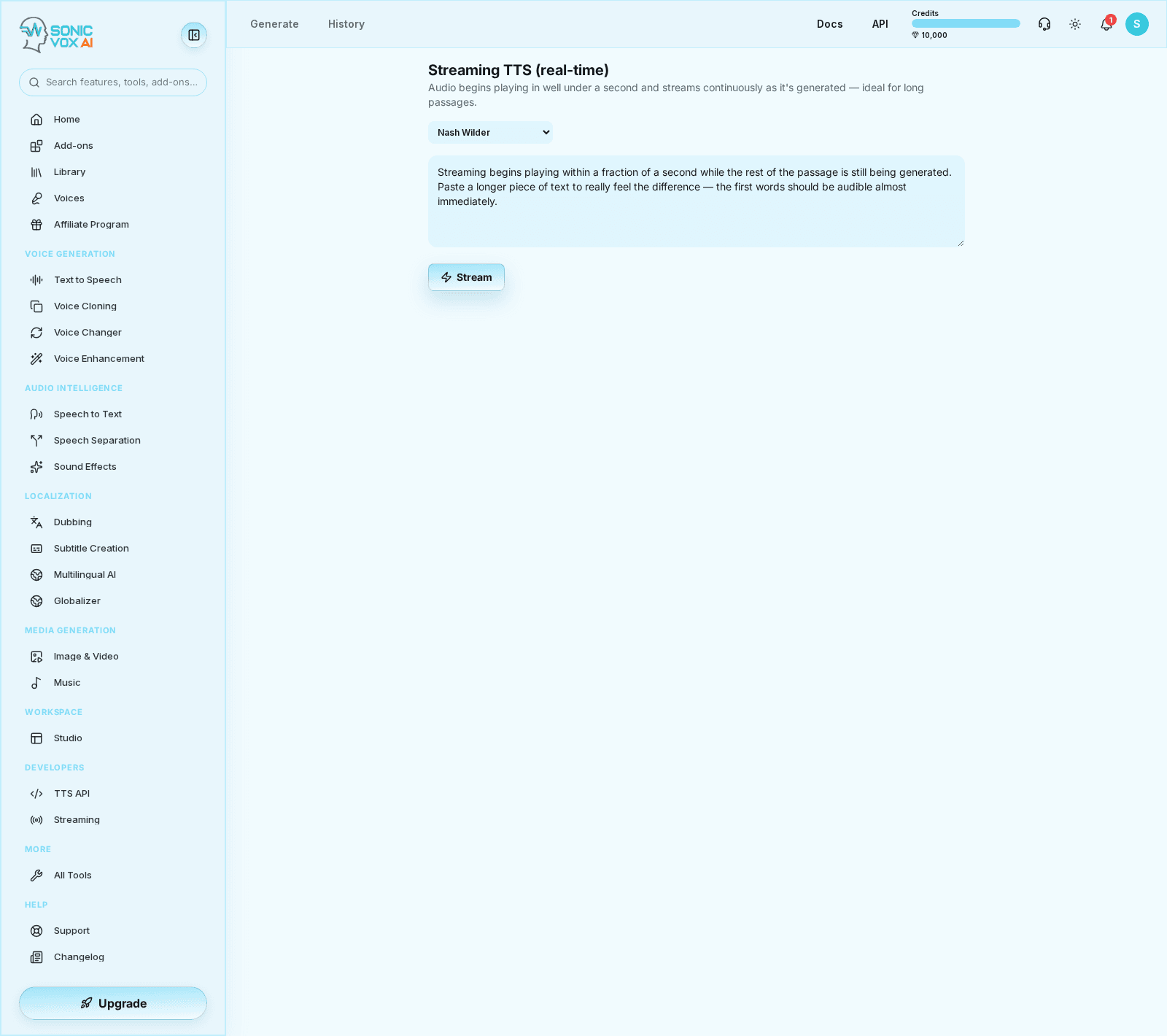
Listen
Every clip below is the same sentence, generated by SonicVox — so what changes between them is the voice, not the writing.
“SonicVox turns your script into natural speech — with the pacing, emphasis, and character you would expect from a studio recording.”
Emma Carter — English
A neutral English read, the kind most narration and product walkthroughs start from.
Marcus Grand — English
A deeper English delivery — the same sentence, so you are comparing voice rather than writing.
So-young Kim — Korean voice
A non-English voice reading the same line, to hear accent carry across the identical script.
Speech engines
Five engines, one API. Pick by what the job needs — the closest voice match, the widest language coverage, or the lowest latency.
Signature
DefaultMost natural — best voice match
Our flagship engine. The most natural-sounding speech with the closest match to your selected voice. Best for narration, ads, and any premium read in 10 major languages.
- Languages
- 10
- Cloned voices
- Yes
- Streaming
- No
en, zh, ja, ko, de, fr, ru, pt, es, it
Studio
Ultra-realistic, expressive
Our newest studio-grade engine — ultra-realistic clones with an expressiveness dial, in 23 languages. Great when you want maximum realism and a touch of drama.
- Languages
- 23
- Cloned voices
- Yes
- Streaming
- No
ar, da, de, el, en, es, fi, fr, he, hi, it, ja, ko, ms, nl, no, pl, pt, ru, sv, sw, tr, zh
Expressive
Lively, dynamic delivery
An expressive engine with naturally dynamic intonation and pacing — a characterful alternative to Signature for narration and dramatic reads. Multilingual.
- Languages
- 16
- Cloned voices
- Yes
- Streaming
- No
- Emotion
- Yes
de, el, en, es, fi, fr, hu, it, ja, ko, nl, pl, pt, ru, tr, zh
Multilingual
30+ languages, incl. Urdu, Hindi, Arabic
The broadest language coverage — 30+ languages and dialects, including ones the other engines can't speak. Renders a designed voice from its written description rather than from a recording, so it can't reproduce a cloned voice. Best for global content.
- Languages
- 30+
- Cloned voices
- From a description
- Streaming
- No
Classic
Fast streaming clone
A fast, lightweight clone engine with low-latency streaming. Mirrors your reference's pacing. Best for quick drafts and real-time use.
- Languages
- 5
- Cloned voices
- Yes
- Streaming
- Yes
en, zh, ja, ko, yue
Key facts
- Cost: 100 credits per 100 characters
- Rounded up, so a 250-character line costs three blocks, not two and a half.
- Request limit: 5,000 characters per request
- Streaming is capped below buffered synthesis (50,000); longer text belongs on POST /api/v1/text-to-speech.
- Streaming: Classic only
- The low-latency endpoints are backed by one engine; the others render a whole take before returning.
- Cloned voices: 4 of 5 engines
- An engine that renders from a written description cannot reproduce a recording-based clone.
Overview
Stream was discovered on the SonicVox route map at /app/speech-synthesis/stream. This page exists so every shipped route has a docs entry to link to; it describes the generic workflow rather than product-specific behaviour, and is replaced the moment a curated guide is written.
Quickstart
This page is an automation-safe starter guide. The generator created it from the route catalog so documentation coverage never falls behind feature rollout.
Open the feature
Go to /app/speech-synthesis/stream and confirm the page loads in your current environment.
Configure the required inputs
Add the source content, choose any voice or processing settings, and verify the request shape before generating.
Run the workflow
Start the generation or processing job and review the initial output before continuing.
Check history and reuse
Save successful outputs, verify how the feature writes to history, and move assets into downstream workflows when needed.
Who this is for
Ideal users
- Operators or product teams validating newly shipped routes
Before you start
- Access to the feature route in the current workspace
- A small real-world sample input for a smoke test
Settings
| Setting | Description | Values |
|---|---|---|
| Inputs | The content, files, or prompt used to start the workflow. | — |
| Processing options | Feature-specific settings that change quality, speed, or style. | — |
| History | The saved outputs area used to replay, compare, or export prior runs. | — |
Use cases
Initial route validation
Use this auto-generated guide to confirm Stream loads, accepts input, and produces an output path worth documenting in more depth.
Examples
Smoke test
Use a short input to verify Stream works end-to-end before scaling up.
Best practices
- Keep a minimal reproducible test input for every feature so automated docs captures remain stable.
- Promote mature auto-generated pages into curated registry entries once the product flow is stable.
Troubleshooting
This auto-generated page feels thin
Likely cause
The route was discovered automatically before a hand-curated guide was added.
What to do
Promote the feature into the manual registry with richer steps, examples, troubleshooting, and capture flows once the product experience stabilizes.
FAQs
Why is this page shorter than other docs pages?
It was created automatically from route discovery so docs coverage does not lag behind shipping features. Add a curated registry entry to expand it.