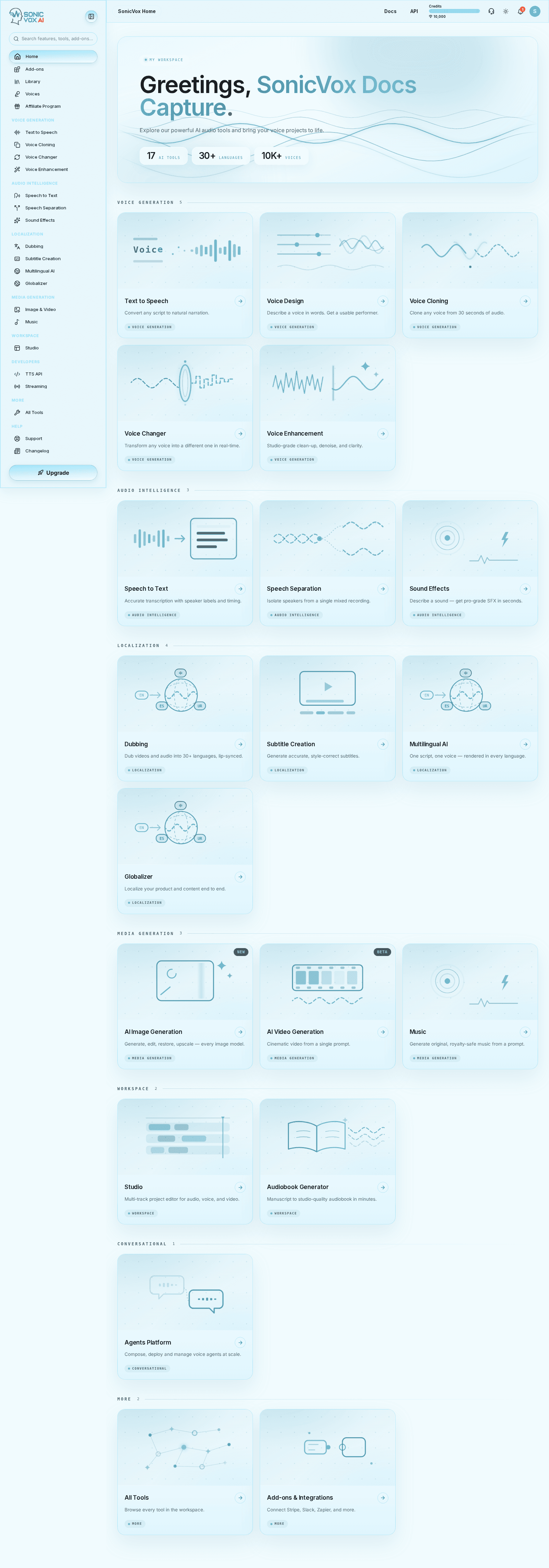
DocsOverview

Getting Started

Launch SonicVox quickly, understand credits, and move from your first voice to your first production workflow.

What you get
WAV download • History entry • Reusable asset in your workspace

What it looks like

Getting Started in SonicVox

Overview

SonicVox is an end-to-end AI audio workspace for speech generation, voice transformation, sound design, transcription, and agent automation. The docs system automatically maps product routes to guide pages, so the catalog stays aligned with the app as features expand.

Quickstart

Use this page as the entry point for the rest of the docs. Start with the feature you plan to use today, then move into Studio or Agents once your core generation workflow is working.

1

Create an account

Sign in with email or Google so your credits, voices, projects, and exports can be persisted.

2

Choose a starting workflow

Use Text to Speech for fast voice output, Voice Cloning for custom voices, or Sound Effects when you need non-speech audio.

3

Generate and review output

Every core feature writes results into history so you can replay, download, or reuse assets in later projects.

4

Move into Studio or Agents

Once you have the source assets, combine them in Studio or wire them into live workflows through the Agents Platform.

Who this is for

Ideal users

  • Creators publishing narration, podcasts, shorts, and explainers
  • Product teams building voice-enabled experiences
  • Operations teams testing internal agent and automation workflows

Before you start

  • A SonicVox account with available credits for short test generations
  • A browser session with access to the core generation tools and Studio
  • At least one script, recording, or prompt you can use as a realistic trial asset

Use cases

Ship a first narrated asset in under an hour

Start with Text to Speech, review the result in history, then move the approved clip into Studio for a polished export.

Prototype an internal voice workflow

Use a cloned voice, a sound effect, and a Studio project to validate whether the team should productionize a larger pipeline.

Prepare for the Agents Platform

Build reusable voices, prompts, and knowledge assets first so live conversational work starts from stable components.

Best practices

  • Keep a short library of approved voices, prompts, and sound styles so your team can move faster.
  • Use history views as the quality-control layer before shipping assets downstream.
  • Treat Studio as the assembly layer and feature pages as the generation layer.

Troubleshooting

I am not sure which feature to start with

Likely cause

SonicVox has both one-shot generators and multi-step production tools, so new users can jump into the wrong layer first.

What to do

Start with the generation surface closest to your input type: script for TTS, sample audio for Voice Cloning or Enhancement, and timeline assembly only after your source assets are approved.

I used credits but still do not have a reusable result

Likely cause

The first run is often treated as exploration and not promoted into history, Studio, or a saved voice workflow.

What to do

After every successful output, immediately decide whether it belongs in history, favorites, Studio, or an agent configuration so the work compounds instead of restarting.

FAQs

What is the fastest path to a production-ready result?

Generate the base asset in the feature-specific workflow, review it in history, then assemble and export in Studio only when the source quality is already approved.

When should I use Studio instead of a feature page?

Use feature pages to create assets. Use Studio when you need sequencing, multiple blocks, transitions, imported clips, or a single mixed export.

Detailed guide

Long-form notes, richer formatting, and implementation context for teams that need more than the quickstart.

Deep dive
Rich formatted reference
Use this section for implementation nuance, workflow depth, and operational guidance that does not fit in a simple checklist.

Getting Started with SonicVox

Welcome to SonicVox! This guide will help you get started with our AI-powered voice and audio platform.

What is SonicVox?

SonicVox is a comprehensive AI voice platform that offers:

  • Voice Cloning - Clone any voice from a short audio sample
  • Text-to-Speech - Convert text to natural-sounding speech
  • Sound Effects - Generate custom sound effects from text descriptions
  • Studio Editor - Multi-track audio editor for creating complete audio projects
  • AI Agents - Build voice-enabled AI assistants

Quick Start

1. Create an account

Sign up at sonicvox.ai with your email or Google account. Signing up with email asks you to confirm you are 18 or over and to pass a quick challenge.

2. Verify your email

We send a link the moment you sign up. Until you click it, every page in the app sends you back to the verification screen — so do this before anything else. Google sign-in skips this step.

3. Generate your first speech

Open Text to Speech, type or paste your script, pick a voice from the library, and click Generate Speech. Nothing to set up first: the library ships with thousands of voices you can use immediately.

4. Download it

Use the download button on the result. You get an MP3 by default; choose WAV or FLAC from the format menu if you need a lossless master.

5. Clone your own voice — Starter plan and above

Open Voice Cloning, drop in a clean recording of the voice you want, name it, and enter a line for it to speak. Voice cloning is not available on the Free plan; you will see an upgrade prompt instead. Everything above works on Free.

Credits System

SonicVox uses a credit-based system. Every price below is the rate the platform actually charges — the app always shows you the exact cost of a job before you confirm it, and the API returns it in the X-Credits-Charged header.

  • New users: the Free plan includes 10,000 credits, refreshed every month
  • Text-to-Speech: 100 credits per 100 characters (rounded up) — 1 credit per character
  • Voice Cloning: 900 credits per cloned voice
  • Sound Effects: 180 credits per generation
  • Speech-to-Text & Subtitles: 300 credits per audio minute
  • Voice Enhancement: 900 credits per audio minute (1-minute minimum)
  • Dubbing: 1,800 credits per minute of source video

Building on the API? POST /api/v1/text-to-speech/estimate prices a request for free without synthesizing anything, and GET /api/v1/account/api-limits returns the live per-endpoint credit table for your plan.

Getting Help

  • Once you are signed in, the Talk to SonicVox button in the app navbar answers questions

about the product directly

  • Email support: support@sonicvox.ai
  • Check our FAQ section for common questions
Was this page helpful?
Getting Started | SonicVox Docs | SonicVox Docs