DocsCore Features

Sound Effects

Generate and manage custom SFX from text prompts, then reuse them in Studio or other projects.

What you get
WAV download • History entry • Reusable asset in your workspace
What it costs

180 credits per generation

  • Flat per generation, whatever duration you ask for (0.5–47 seconds).
  • High quality requires a plan with HQ audio; other plans are served standard quality.

What it looks like

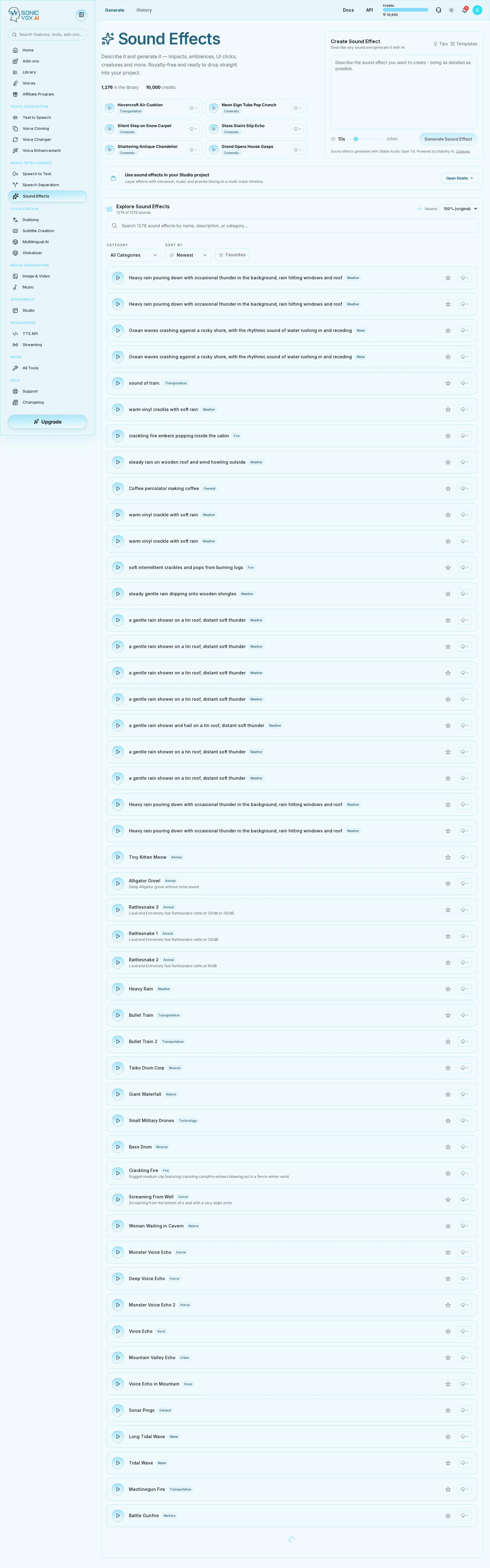
Sound Effects in SonicVox

Overview

Sound Effects is the SonicVox workflow for prompt-based audio generation. It turns short natural-language prompts into downloadable audio assets that can also be inserted into Studio projects.

Quickstart

1

Describe the sound

Write a concrete prompt that includes source, environment, and intensity.

2

Adjust generation choices

Tune the request before generation so the model has enough context to produce the right effect.

3

Generate variations

Create outputs, review them, and star or save the takes you want to reuse.

4

Use the clip downstream

Download the result or insert it into Studio for timeline composition.

Who this is for

Ideal users

  • Video and podcast teams needing custom transitions and ambience
  • Product teams generating UI feedback and notification sounds
  • Studio users building layered audio scenes without external sound libraries

Before you start

  • A prompt that describes source, space, mood, and intensity rather than only keywords
  • A clear idea of whether the effect will be foreground, transition, or background texture
  • A plan for where approved takes will live: favorites, history, or Studio

Settings

SettingDescriptionValues
PromptThe main textual description for the desired effect.
Library / favoritesLets you revisit or reuse successful generations without starting from zero.
HistoryTracks previous generations for fast comparison and recovery.

Use cases

Branded interface sounds

Create confirmation tones, warning sounds, and short interaction cues that match a product's personality.

Scene-building ambience

Generate weather, room tone, motion, and environmental detail to make spoken content feel situated and cinematic.

Fast replacement for stock SFX browsing

Describe exactly the effect you need instead of searching through long generic libraries and manually stitching alternatives.

Examples

Cinematic ambience

Create a detailed environmental bed for video or podcast storytelling.

Rain falling on a tin roof with distant thunder and a soft room-tone indoors.

UI feedback

Build short branded sounds for notifications, transitions, or interface feedback.

Short futuristic confirmation chime with a clean digital tail.

Best practices

  • Write prompts as if you were briefing a sound designer, not a keyword list.
  • Save the best generations into favorites so Studio users can browse a curated set.
  • Use short, distinct effects when the asset will sit under spoken dialogue.

Troubleshooting

The generated sound is too generic

Likely cause

Prompts that only name an object or category do not communicate environment, timing, or emotional tone.

What to do

Rewrite the prompt as a short production brief with source, setting, texture, and intended role in the final mix.

The effect competes with speech in Studio

Likely cause

The generated take is too dense, too long, or too bright for a supporting role under narration.

What to do

Prompt for shorter or softer variants, then use Studio to place the effect only at transitions or lower-intensity moments.

FAQs

Should I generate one perfect SFX or several variations?

Generate a few focused variations first. It is faster to compare two or three targeted takes than to overfit one very broad prompt.

How do I reuse the best sounds later?

Save approved effects into favorites or keep them accessible in history, then insert them into Studio projects when assembling the final timeline.

How long can a generated sound effect be?

0.5 to 30 seconds. One-shots for impacts and clicks, longer beds for ambience. Regenerate as many times as you want — credits are pooled across the platform.

Which model powers the generation?

We route to the best commercial-licensed audio model available. New models added as they ship — you keep one API and one bill.

Are the generated effects mine to use commercially?

Yes. Output is yours under the underlying model's commercial license. Standard plans cover commercial use; enterprise plans add indemnification.

What formats and quality?

48 kHz broadcast quality. Export as MP3 or WAV. Clean transients, immersive stereo where appropriate.

Can I match an existing sound or library?

Describe what you want in the prompt — style, materials, environment, mood. The more specific, the closer the match. Regenerate with tweaks until it's right.

How does it integrate with the rest of SonicVox?

Generated SFX drops straight into Studio. Pair with TTS narration, dub the result into 25+ languages, render the video — same project, no exports between tools.

Detailed guide

Long-form notes, richer formatting, and implementation context for teams that need more than the quickstart.

Deep dive
Rich formatted reference
Use this section for implementation nuance, workflow depth, and operational guidance that does not fit in a simple checklist.

Sound Effects Generation Guide

Create custom sound effects from text descriptions using AI.

What is SFX Generation?

SonicVox's SFX generator uses AI to create unique sound effects based on your text descriptions. Simply describe the sound you want, and AI generates it.

How to Generate Sound Effects

Step 1: Open SFX Generator

Navigate to Sound Effects in the sidebar or access from Studio Editor.

Step 2: Describe Your Sound

Enter a detailed description, up to 500 characters — the counter under the box shows how much you have left:

  • ✅ Good: "Thunder rolling in the distance with light rain"
  • ❌ Vague: "Weather sound"

Step 3: Set the Length

Drag the Duration slider beside the counter. It runs from 1 to 47 seconds and starts at 10. The price is flat per generation, so a 47-second effect costs the same as a 1-second one.

Step 4: Generate

Click Generate Sound Effect. The button reads Creating... while the model renders; longer effects take longer.

Quality is not a control the app exposes: every request from the generator asks for high quality, and accounts on a plan without HQ audio are served the standard render instead — the generation still succeeds, it is simply not the high-fidelity version. Over the API you can ask for "standard" or "high" explicitly, with the same clamp applied.

Step 5: Preview and Save

Listen to the result, then save to your library or download.

Writing Effective Prompts

Be Specific

  • "Metal door slamming shut in an empty warehouse"
  • "Gentle ocean waves on a sandy beach at sunset"

Include Environment

  • "Footsteps on wooden floor in a quiet room"
  • "Car horn honking in busy city traffic"

Describe Intensity

  • "Soft whisper of wind through leaves"
  • "Loud explosion with debris falling"

Sound Categories

CategoryExamples
NatureRain, thunder, wind, birds
MechanicalEngines, gears, machines
HumanFootsteps, breathing, crowds
Sci-FiLasers, robots, spacecraft
HorrorCreaks, screams, eerie ambience

Using SFX in Studio

  1. Open your project in Studio Editor
  2. Open the Sound Effects tab in the right sidebar
  3. Search the library and click an effect to add it, or click Generate New Sound Effect, describe the sound, set its duration, then Add to Timeline
  4. Adjust timing and volume

<!-- No "## Credits" section here on purpose. The docs page renders "What it costs" automatically from scripts/docs/pricing.ts, which derives the rate from CREDIT_COSTS.SOUND_EFFECT. A hand-written duplicate is a second number that can drift — which is exactly how this guide came to publish 100 credits against a real 180 for four months. One source, one place. -->

Was this page helpful?
Sound Effects | SonicVox Docs | SonicVox Docs